


In today’s classrooms, auditoriums, and training rooms, the podium is no longer just a piece of furniture it’s the command center of every presentation. As teaching methods evolve and institutions invest in smarter infrastructure, decision-makers are increasingly asking a practical question: Should we continue with a traditional podium, or upgrade to a digital podium?
This guide offers a clear, experience-backed comparison to help school principals, trustees, IT/AV heads, procurement teams, and corporate training leaders make an informed, future-ready choice.
Why Podiums Matter More in Modern Classrooms
The podium sits at the intersection of content delivery, technology control, and audience engagement. In a smart classroom or professional training environment, the effectiveness of a session often depends on how seamlessly the presenter can:
- Control audio-visual equipment
- Switch between content sources
- Engage learners visually and interactively
As institutions adopt classroom presentation tools like interactive displays, projectors, and visualizers, the podium’s role has expanded significantly.
What Is a Traditional Podium?
A traditional podium is typically a fixed or movable lectern designed primarily to hold notes or a laptop.
Common Use Cases
- Basic lectures with minimal AV usage
- Ceremonial speeches
- Occasional presentations
Limitations
- Requires external AV control systems
- Multiple cables and devices on the desk
- Presenter often moves between the podium, laptop, and control panel
- Limited scalability for smart classrooms
While traditional podiums still serve a purpose in low-tech environments, they often struggle to support modern teaching and training workflows.
What Is a Digital Podium?
A digital podium (also called a digital lectern for schools) integrates AV control, display management, audio systems, and connectivity into a single unit.
Core Capabilities
- Built-in touchscreen or display
- Centralized control for projectors, interactive panels, and audio
- Multiple input options (HDMI, USB, LAN)
- Support for BYOD (Bring Your Own Device)
- Optional visualizer integration for real-object teaching
In essence, a digital podium transforms the presenter’s experience from managing devices to delivering content.
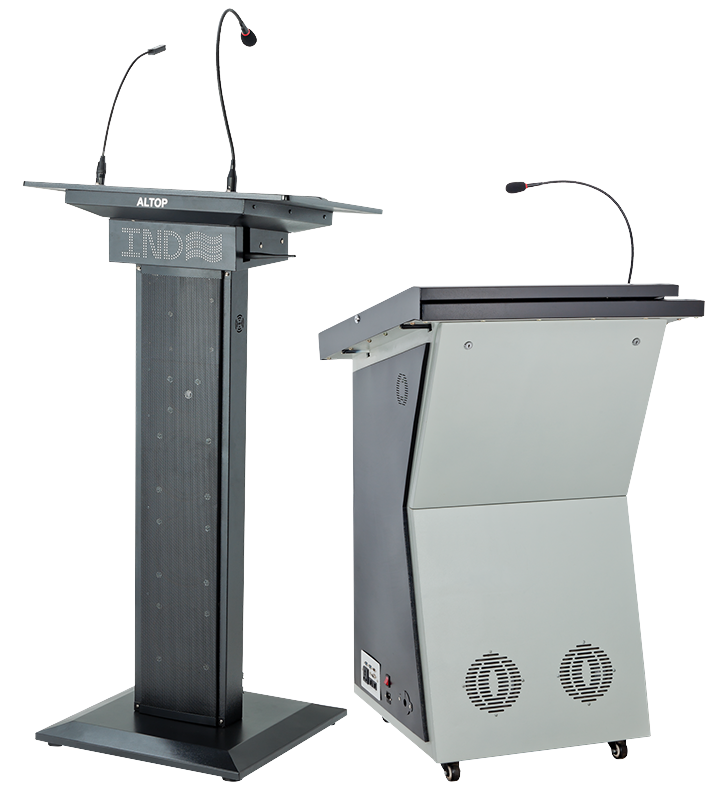
Feature-by-Feature Comparison
| Criteria | Traditional Podium | Digital Podium |
|---|---|---|
| Setup & Connectivity | External AV devices manual wiring | Integrated AV control, single-point connectivity |
| Ease of Use | Requires Technical Familiarity | Intuitive interface, minimal training |
| Teaching Efficiency | Frequent Interruptions | Smooth, uninterrupted flow |
| Audience Engagement | Limited Interaction | Multimedia, Visual, and interactive delivery |
| Infrastructure Requirements | Additional control panels needed | Works with existing AV infrastructure |
| Scalability & Future Readiness | Limited | Designed with smart classrooms and hybrid learning |
Impact on Teaching & Presentations
Digital podiums significantly improve teaching effectiveness by:
- Reducing time spent on setup
- Allowing quick switching between content sources
- Supporting visual and object-based teaching through visualizers
- Enhancing presenter confidence and audience attention
For subjects like engineering, science, medical training, or corporate workshops, the ability to display real objects, zoom into details, and annotate content live can be transformative.
Maintenance, Service & Long-Term Costs
While traditional podiums appear cost-effective upfront, institutions often underestimate:
- Maintenance of multiple external AV components
- Downtime due to wiring or control failures
- Upgrade costs when adding new technology
Digital podiums, when sourced from reliable manufacturers, consolidate systems into one unit—simplifying maintenance and reducing long-term operational costs.
ALTOP Industries designs digital podiums with in-house production, faster delivery, and strong after-sales support, making them particularly suitable for Indian institutional environments.
Which Podium Is Better for Your Institution?
Schools
- Digital podium is ideal for smart classrooms and hybrid teaching
- Supports interactive lessons and teacher mobility
Colleges & Universities
- Digital podiums enhance large lectures, seminars, and technical demonstrations
- Suitable for auditoriums and specialized labs
Auditoriums
- A digital podium for auditoriums offers centralized AV control and professional presentation quality
Corporate Training Rooms
- Enables smooth switching between trainers, devices, and content
- Enhances professionalism and session efficiency
Common Myths About Digital Podiums
Myth 1: Digital podiums are too complex
Reality: Modern digital podiums are designed for intuitive use with minimal training.
Myth 2: They require a complete infrastructure overhaul
Reality: Most digital podiums integrate easily with existing AV setups.
Myth 3: Maintenance is difficult
Reality: Integrated systems often reduce overall maintenance complexity.
Upgrading Without Overhauling Infrastructure
Indian institutions can adopt digital podiums incrementally:
- Start with key classrooms or auditoriums
- Use existing displays and projectors
- Scale gradually across campuses
Choosing manufacturers with local support, customization options, and quick service response ensures a smooth transition.
Making a Future-Ready Choice
The choice between a traditional podium and a digital podium reflects how an institution views the future of teaching and communication. While traditional podiums serve basic needs, digital podiums align with the demands of smart classrooms, modern auditoriums, and professional training environments.
Institutions planning to upgrade their classrooms or auditoriums should evaluate solutions that combine technology, usability, and long-term support—ensuring their investment delivers value for years to come.
📧 [email protected] | 📞 +91 90828 88796 | 🌐 www.altop.com